Removal, trimming, storm cleanup, and stump grinding across Lumberton and Robeson County. Free written estimates before any work.
Call (555) 555-5555Or call — we answer. No obligation, honest advice.
This county has learned water the hard way. Matthew put the Lumber River into living rooms in 2016 and Florence did it again two years later, and both times the part people remember least turned out to matter most: what happens after the water goes down.
Here is the thing worth understanding, because almost nobody says it plainly. Floodwater drains off the surface long before it leaves the ground. Soil stays saturated for weeks, and saturated soil does not hold roots the way dry soil does. So a tree can stand through the storm itself, look completely untouched afterwards, and then come over in an ordinary gusty afternoon a month later. The dangerous window in Robeson County is not the storm. It is the six or eight weeks that follow it, when the ground is still soft and nobody is thinking about trees anymore.
The county's canopy sorts into three groups. River hardwoods along the Lumber sit in ground that floods and loosens repeatedly. Farm-edge pines shade equipment yards and line the fields. And in-town oaks planted generations ago have grown up into rooflines and power drops they were never planted to reach.
The way this works is simple. Somebody looks at the tree, tells you honestly what it needs, writes the estimate down, and turns up on the day. Cleanup and haul-off are inside a removal price from the start. And when a tree is fine, you get told it is fine.
The plan comes before the saw. Where the tree can go, what sits under it, how the weight moves as it comes apart, and whether the ground will carry equipment at all - on soft river-bottom soil that last question decides the whole approach.
Sites get raked before we leave. On saturated ground that also means thinking about the route in, because a machine that cuts ruts across a wet yard has traded one problem for another.

Removal, trimming, and stump grinding handle most of what a Robeson County property needs, with storm response when the river has other ideas.
Dead, leaning, and storm-loosened trees taken down safely, including tight work near houses and outbuildings. Cleanup and haul-off included in the price.
Deadwood out, clearance over roofs, drives, and service lines, and structural work on younger trees. Cuts placed where the tree can seal them.
Stumps taken below grade so ground can be replanted, sodded, or just mowed across without steering around it.
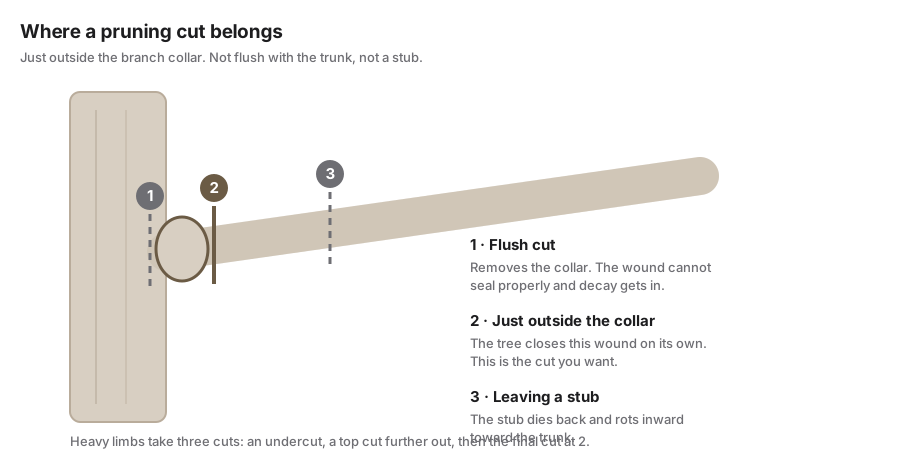
Pruning goes wrong in one place more than any other: the position of the cut. Look at where a limb meets the trunk and you will see a slight swelling, a raised ring around the base. That is the branch collar, and it holds the tissue the tree uses to grow over a wound. Cut immediately outside it and the tree closes itself.
Cut through the collar, flush against the trunk, and you have taken away the thing that does the healing - the opening stays open and decay works inward. Leave a stub sticking out instead and the stub dies, then rots back down into the trunk. Both are permanent, both take a few years to show, and by then whoever made the cut is long gone.
Weight needs three cuts, not one. An undercut, a second cut further out to drop the load, then the finishing cut at the collar. Take a heavy limb in a single pass and it tears free before the blade is through, ripping bark down the trunk on the way.
A root plate holds a tree up by gripping soil. That grip depends on the soil being firm, and after a flood it is not firm for a long time - well past the point where the yard looks normal again and the water line on the siding has been painted over.
That produces a specific and underappreciated risk. Trees that survived the storm intact are the ones that fail afterwards, in weather nobody would think twice about. There was no dramatic event to connect it to, which is exactly why it catches people out. If your property flooded this season, the trees near the house deserve a look in the months after, not just in the week of.
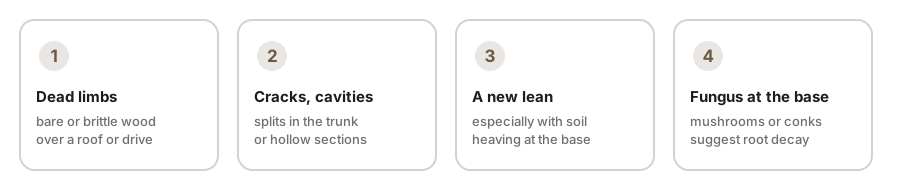
What to look for is straightforward. Soil cracked, lifted, or heaved on one side of a trunk means the plate has already begun to move, and that is the most urgent sign there is. A lean that was not there before. Trees along the river that have been through repeated floods and are showing thinner crowns each year. And the ordinary indicators that apply anywhere - dead limbs in the canopy, cracks or hollows in the trunk, mushrooms or shelf fungus at the base.
Two things do real damage in this county specifically. Equipment parked under farm-edge trees compacts the root zone season after season, and compacted soil is already halfway to failing before a flood arrives. And topping - cutting a crown back to stubs - forces weak regrowth from every wound. On ground that goes soft every few years, that is the last thing a tree needs.
None of these means a tree is finished. All of them are cheaper to have looked at in a dry month than dealt with after something falls.
Same sequence every time, whether it is one limb over a porch or a row of pines along a field.
Someone looks at the actual tree and writes the number on paper. Cleanup and haul-off are inside it. What you agreed to is what you get billed.
If something unexpected turns up mid-job we stop and talk to you before doing anything that changes the price. Nobody should get handed a bill they did not agree to.
Debris hauled, chips cleared, and care taken about ruts on soft ground. The job is not done until the yard is right.
A lot of Robeson County tree work is not in a yard at all. It is the pine row along a field, the hardwoods crowding a farm road, the limbs hanging low enough that a combine has to steer around them, or the dead tree over the equipment yard that everyone parks under anyway.
That work runs on a different calendar than residential jobs. There is no sense taking down a fence-line tree during harvest, and there is every sense doing it in the stretch when the fields are empty and the ground is firm enough to carry a truck. Tell us what your season looks like and the schedule can be built around it rather than against it.
Field-edge trees also fail differently. They have grown up in the open with one side exposed to prevailing wind, so their crowns are frequently lopsided and their root plates are compacted on the side where equipment turns. Both matter when the ground softens. A row that has stood for thirty years is not automatically a row that will stand through the next wet autumn, and walking it while the weather is dry costs nothing.
Lumberton is the base, and the service area covers Robeson County - Pembroke, Red Springs, Fairmont, St. Pauls, Maxton, Rowland, Parkton, Lumber Bridge, Orrum, and Proctorville. That takes in the river hardwoods along the Lumber, the farm edges, and the older in-town streets where the oaks have outgrown the space they were given.
Travel is part of the quote toward the far corners of the county, and we will tell you that on the phone rather than putting it on the invoice later. If you are just past the list below, call and ask.

Money is earned hard in this county and tree work is not cheap, so the pricing here is deliberately plain. Estimates are free, they are written down before anything starts, and the figure on that paper is the figure on the invoice.
What actually drives the number is worth knowing so you can judge any quote, ours included. Size and species matter, but access matters more than either - a pine that can be felled whole in an open field is a fundamentally cheaper job than the same pine standing between a house and a shed, because the second one has to come down in pieces on ropes. Cleanup is the other variable, and it is where cheap quotes hide: always ask whether hauling the debris away is included, because a low number that leaves a tree lying in your yard is not a low number.
One warning that this county earned the hard way. After both floods, crews arrived from out of the area knocking on doors, asking for cash, and wanting money up front. Some were legitimate. The ones that took deposits and disappeared were not. Apply the same rules to anybody, including us: get the scope in writing first, do not hand over a large deposit before work begins, and ask for a certificate of insurance sent to you straight from the insurer rather than shown to you as a photocopy. Tree work is dangerous enough that an uninsured crew working on your property becomes your problem if something goes wrong.
Estimates are free and in writing. Removal is priced on size, species, and access; trimming on scope; stump grinding on diameter and how many. Nothing gets quoted properly over the phone, because the yard is where the price actually lives.
Call (555) 555-5555 for removal, trimming, storm cleanup, or stump grinding anywhere in Lumberton and Robeson County. If your ground took water this year, the trees near the house are worth a look before the next windy stretch rather than after it.
Tell us what you need and we'll get back to you with a real answer. If it's an active backup or standing water over the field, calling gets you a faster response.
Call: (555) 555-5555
Area: Lumberton, NC and Robeson County